 Advisory Wizard
The file takes longer than the advice
The thinking is done in the meeting. The rest of the week goes on writing it up: fact finds, research, reports, review packs. It is the least valuable time an adviser spends and the hardest to protect.
Advisory Wizard is an AI-assisted financial planning platform. It drafts the fact find, the risk profile, the cashflow and the suitability report. Every one of them then goes in front of a named adviser to review, amend and affirm before a client ever sees it.
Advisory Wizard is technology for authorised financial advisers. It does not provide financial advice, and no output of the platform is a personal recommendation.
Why now
Every advice firm in the country is feeling at least two of these. Most software answers only the first.
The thinking is done in the meeting. The rest of the week goes on writing it up: fact finds, research, reports, review packs. It is the least valuable time an adviser spends and the hardest to protect.
Good outcomes now have to be evidenced rather than asserted, at the file level and across the book. That evidence has to come out of the same records the advice was built on, or it is a second job.
Advisers are already using general-purpose AI tools. The question a principal has to answer is not whether AI is in the process, but whether the firm can explain what it did and prove who decided.
The platform
Planning tools built for the way advice is actually done, with the client record underneath all of them, so nothing is typed twice and nothing is assembled the night before a review.
A structured digital fact find, client questionnaires that clients actually finish, and onboarding that runs from letter of authority through to electronic signature.
Attitude to risk, capacity for loss and required return, each with a written rationale, and the adviser's judgement recorded alongside the score rather than hidden behind it.
Projections and Monte Carlo stress-testing, with every assumption stated on the face of the output and changeable in front of the client.
Drafts the full report from the file (objectives, rationale, risks, costs and charges) and flags every gap it cannot answer for the adviser to complete.
With the client's consent, records the meeting and drafts the notes, the actions and the follow-up email. The adviser edits and approves before anything reaches the file.
Annual review packs built from current holdings and valuations, so the pack is ready for the meeting instead of being assembled the night before it.
Characteristics of vulnerability captured, reviewed and evidenced as part of the file, with the sensitive detail handled to a higher standard than the rest of the record.
Reads provider statements and policy documents and pulls the figures into the file, with the source shown beside every number and conflicts flagged rather than silently resolved.
File-completeness checking, price-and-value assessment and outcomes MI, produced from the same records the advice was built on, not re-keyed into a separate spreadsheet.
Inside the platform
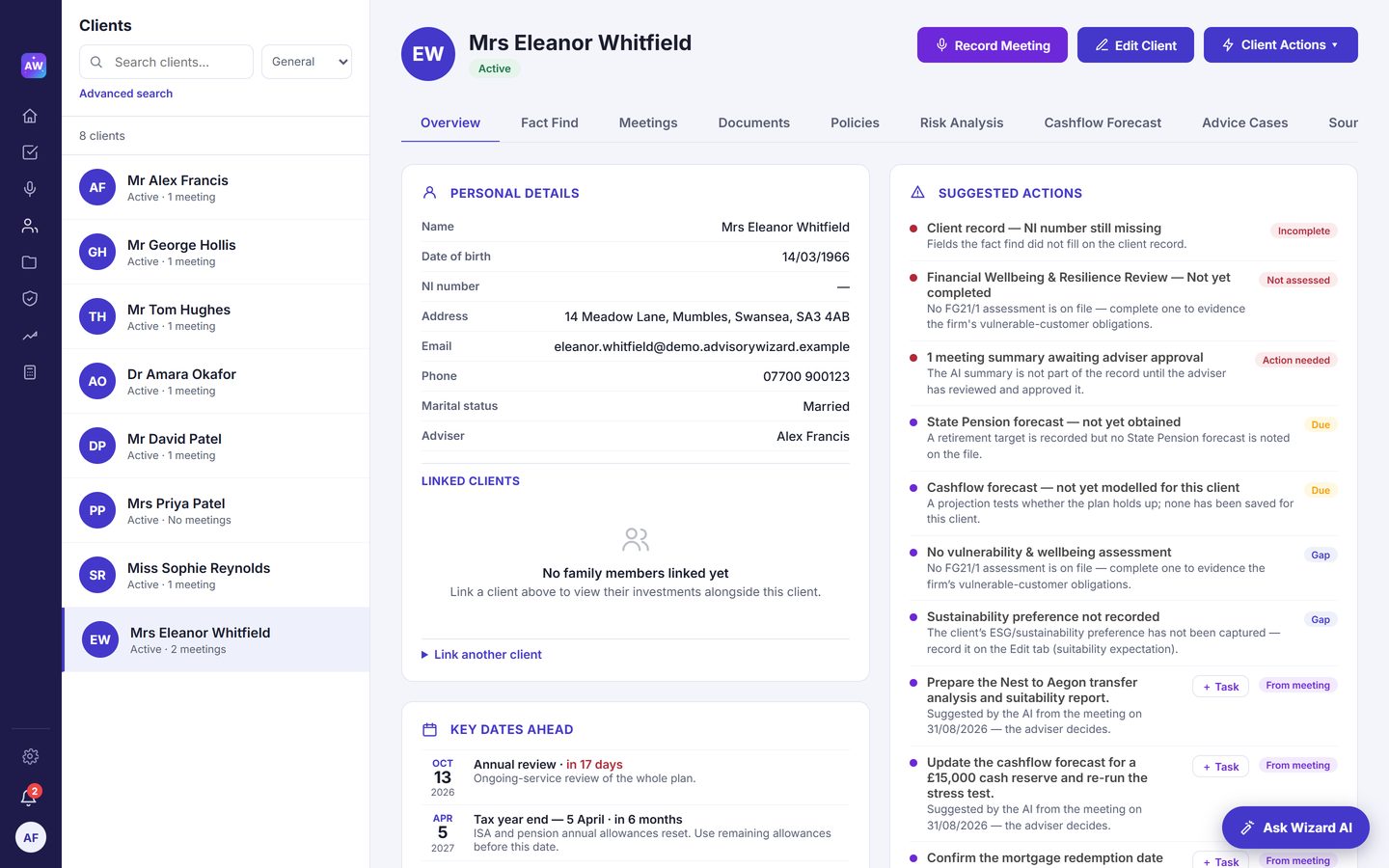
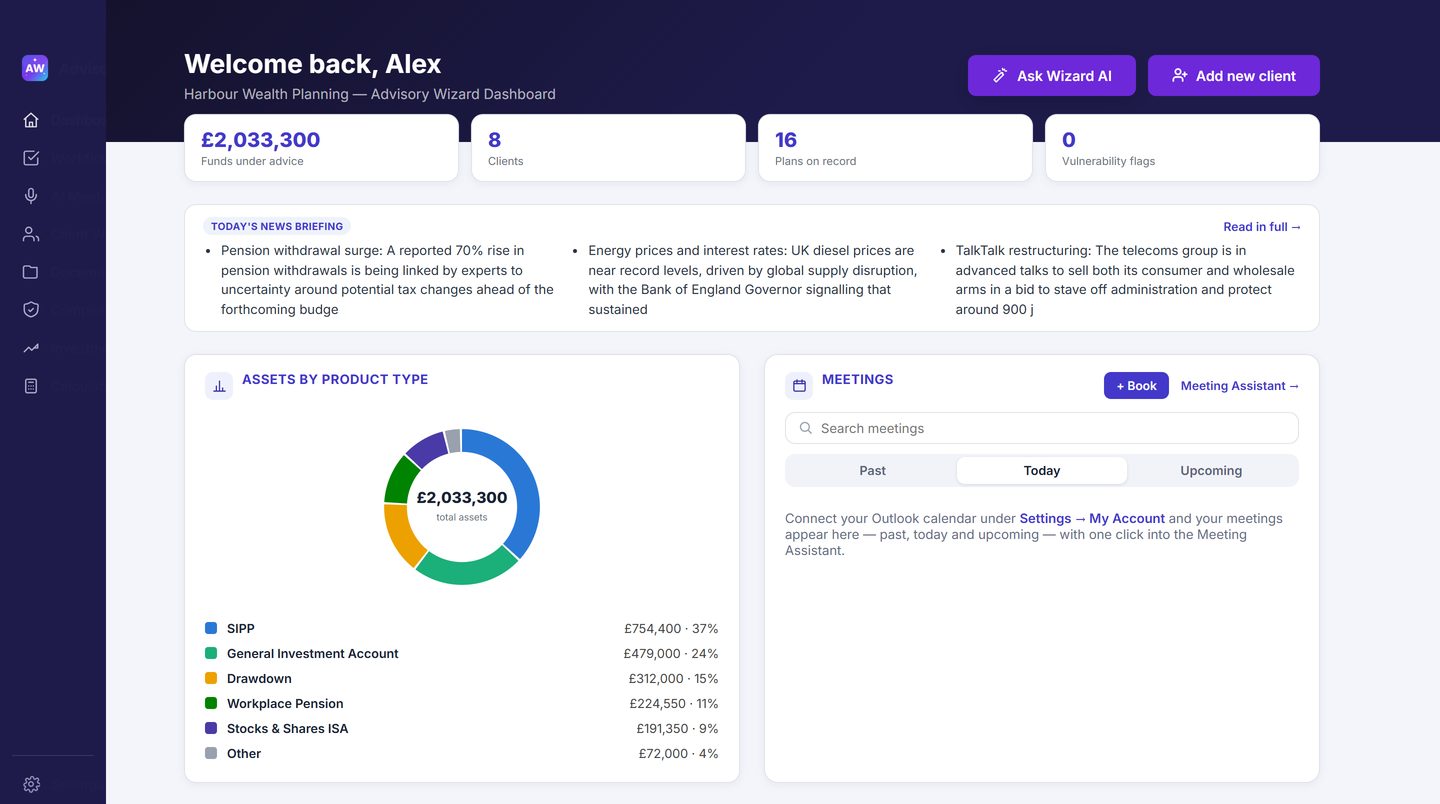
The whole file in one place: personal details, linked family, plans, documents, meetings and the advice history. Every gap on the file is listed as a suggested action, so a missing NI number or an unassessed vulnerability is found on the day, not at the review.
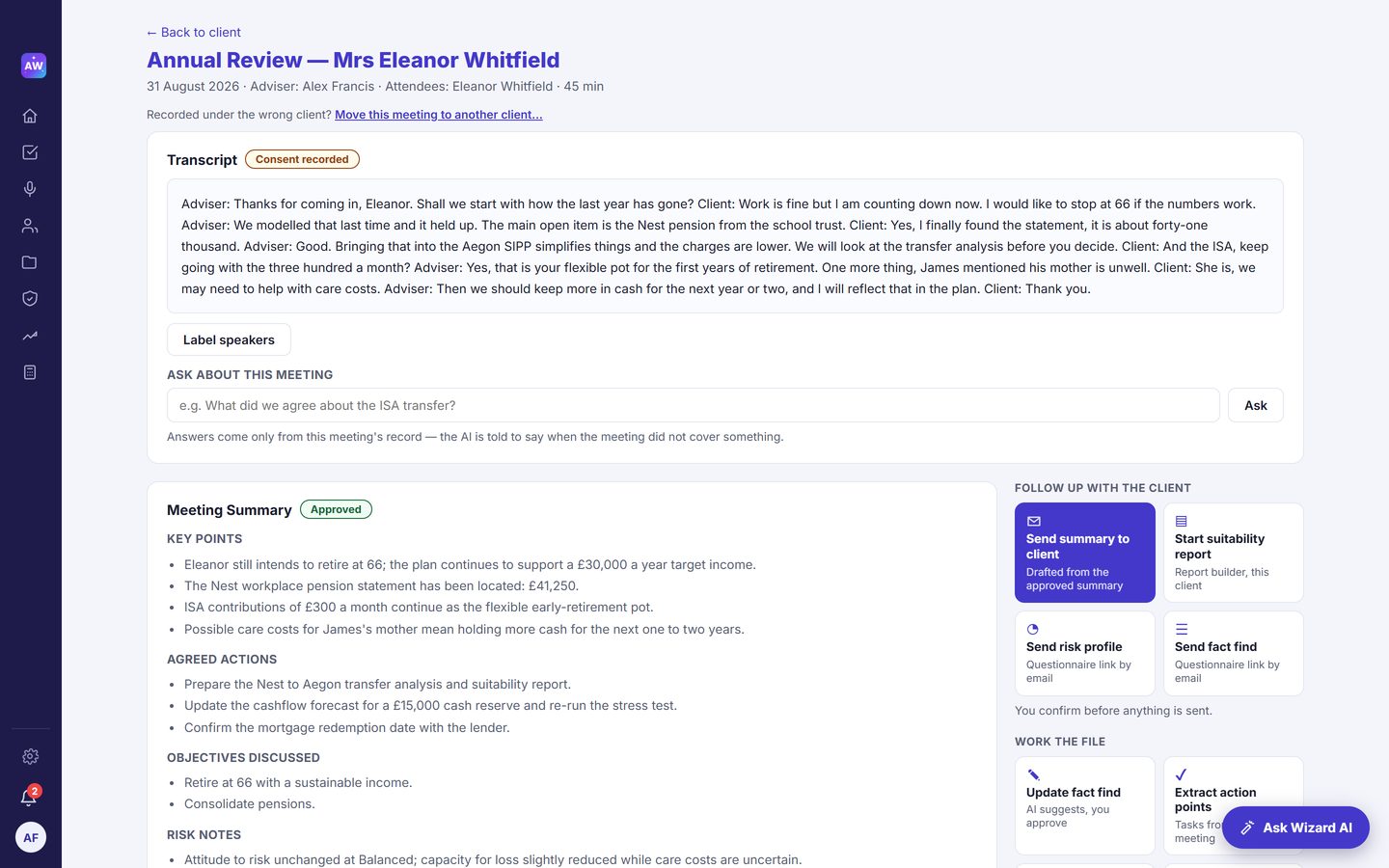
With the client's consent the meeting is recorded, and the transcript, the summary and the agreed actions are drafted from it. The adviser corrects and approves each part. Nothing reaches the client or the file until that approval is given, and the approval itself is on the record.
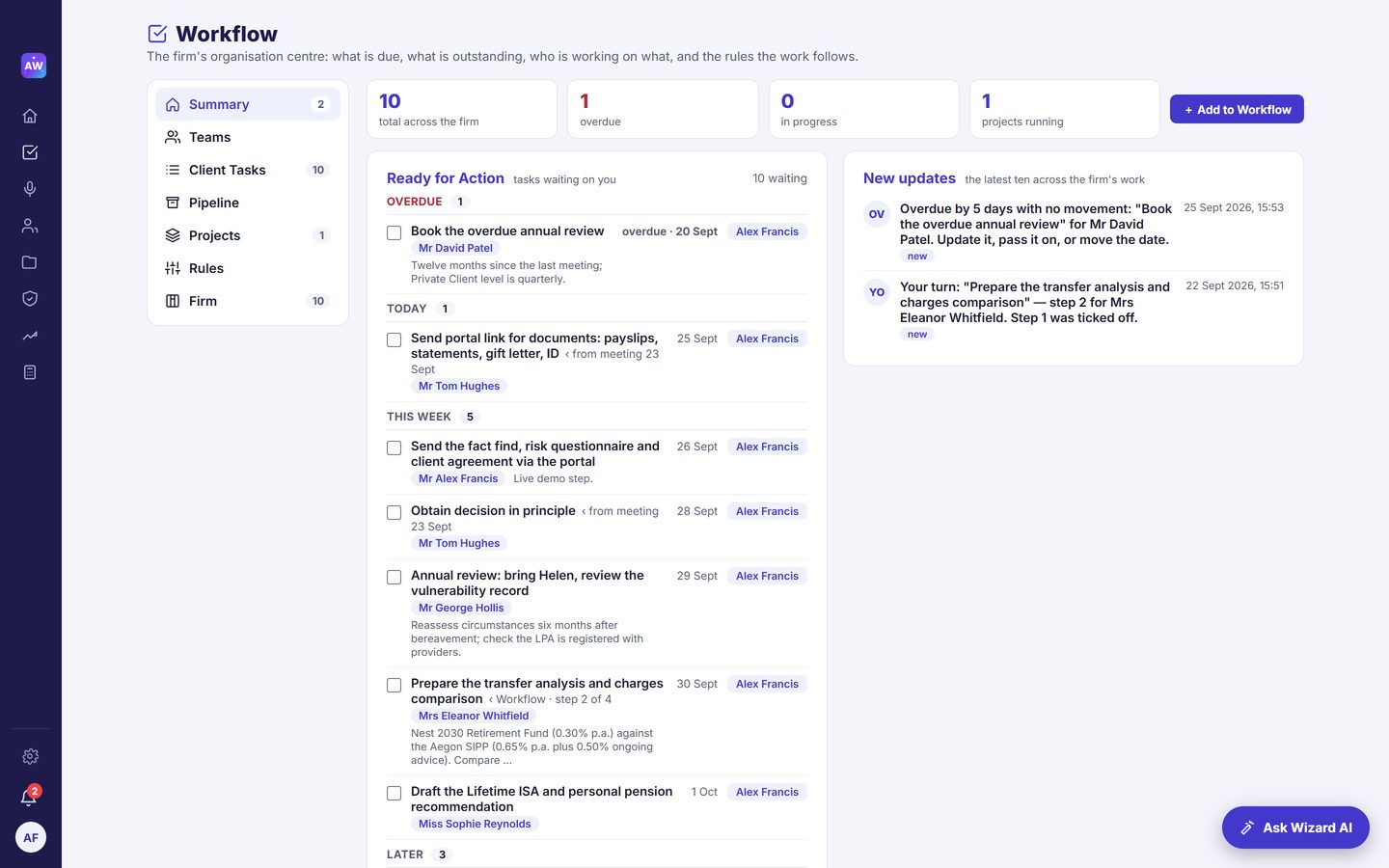
What is due, what is outstanding and who is working on what. Tasks arrive from approved meetings, from advice cases and from the firm's own rules, land with the right person, and show up as overdue before a client has to ask.
Our approach
Accountability for client outcomes does not transfer to a software provider, however capable the technology. Advisory Wizard is designed on that assumption rather than around it.
There is no route from an AI draft to a client without a named adviser reviewing, amending and affirming it in between. That is enforced by how the software is built, not promised in a policy document.
Deterministic suitability and risk logic sets the boundaries the AI works inside. It is the hybrid design of rules plus machine learning that produces an output a firm can actually explain afterwards.
Every AI contribution is logged: what was suggested, when, by which version of the system, and what the adviser decided to do with it. When someone asks how an outcome was reached, there is an answer on file.
We do not train AI models on your clients' information. Personal identifiers are minimised before anything is sent for processing, and the most sensitive fields are encrypted at rest.
These commitments are our answer to the FCA's Mills Review, published on 6 July 2026, the first regulator-led study of how AI will reshape retail financial services. Its analysis is direct: the existing framework works where the human decides, and comes under strain where the human is reduced to observing. We intend to stay, permanently, on the side where the adviser decides. Read our full response to the Mills Review.
Who built it
Advisory Wizard was not specified in a workshop and handed to a development team. It was built by a practising chartered financial planner, inside a working UK advice firm, to solve the problems that were costing him his own week, and it has been used on real client work throughout.
That shows up in two places. The first is the detail: the software assumes how advice is genuinely done: households rather than individuals, reviews that arrive whether or not the file is ready, clients who answer half a questionnaire. The second is the compliance thinking, which is structural rather than a layer added at the end. When the person writing the software is the person who has to defend the file, the evidence trail stops being a feature request.
It is also why the roadmap is deliberately narrow. Advisory Wizard is planning-led practice software for advice firms. It is not a platform, not an asset manager, and it will not be moved into giving advice.
Company
We would rather tell you exactly what stage this is at than imply a scale we have not reached.
 Certified
The National Cyber Security Centre's scheme, certified by ITCS with IASME. Certificate dated 24 September 2026, renewed annually.
Verify on the public registry
Certified
The National Cyber Security Centre's scheme, certified by ITCS with IASME. Certificate dated 24 September 2026, renewed annually.
Verify on the public registry
Get in touch
The most useful demonstration is your own file type, not ours. Tell us the firm, roughly how many advisers you have, and when suits, and we will walk you through it end to end.